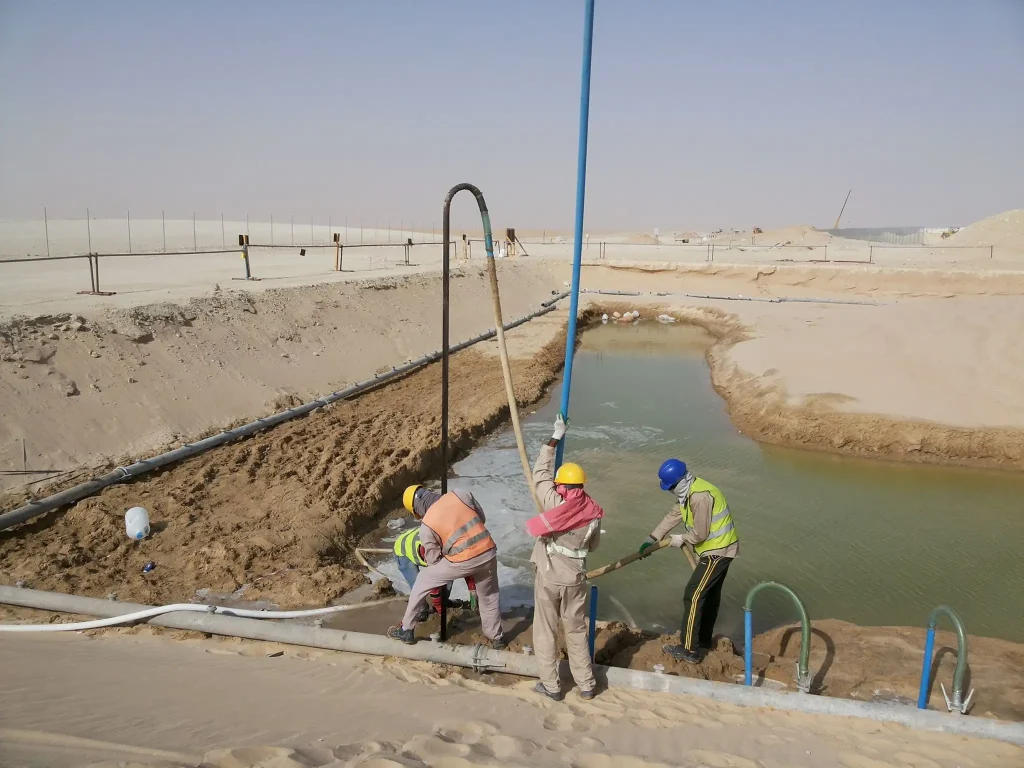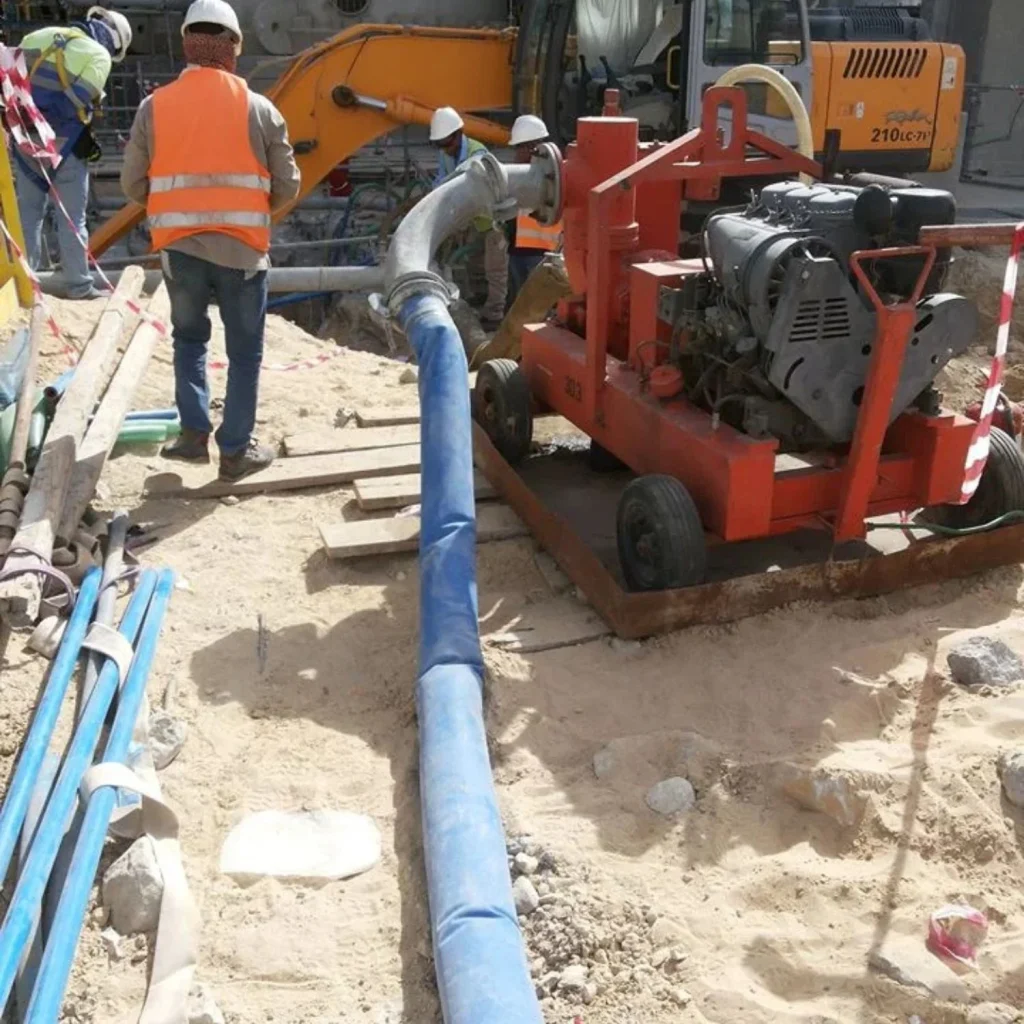

Water is one of the first challenges a contractor can face when excavation begins.
Groundwater can enter an excavation from surrounding soil. Rainwater can collect in open trenches. Pipeline works can encounter unexpected water inflow. Construction sites near coastal or industrial areas can also deal with difficult water-control conditions.
If water is not controlled properly, excavation can become unsafe, equipment can be affected, and construction activities may slow down.
This is where a centrifugal diesel driven dewatering pump becomes an important part of the site equipment.
For contractors working in Dammam, Al Khobar and Jubail, selecting the right dewatering pump is not simply about choosing the largest pump available. The pump needs to match the water inflow, required flow rate, discharge head, suction conditions, solids content, operating hours and overall site requirements.
This guide explains how centrifugal diesel driven dewatering pumps work, where they are used, why contractors prefer them for demanding applications and what should be considered before selecting one.
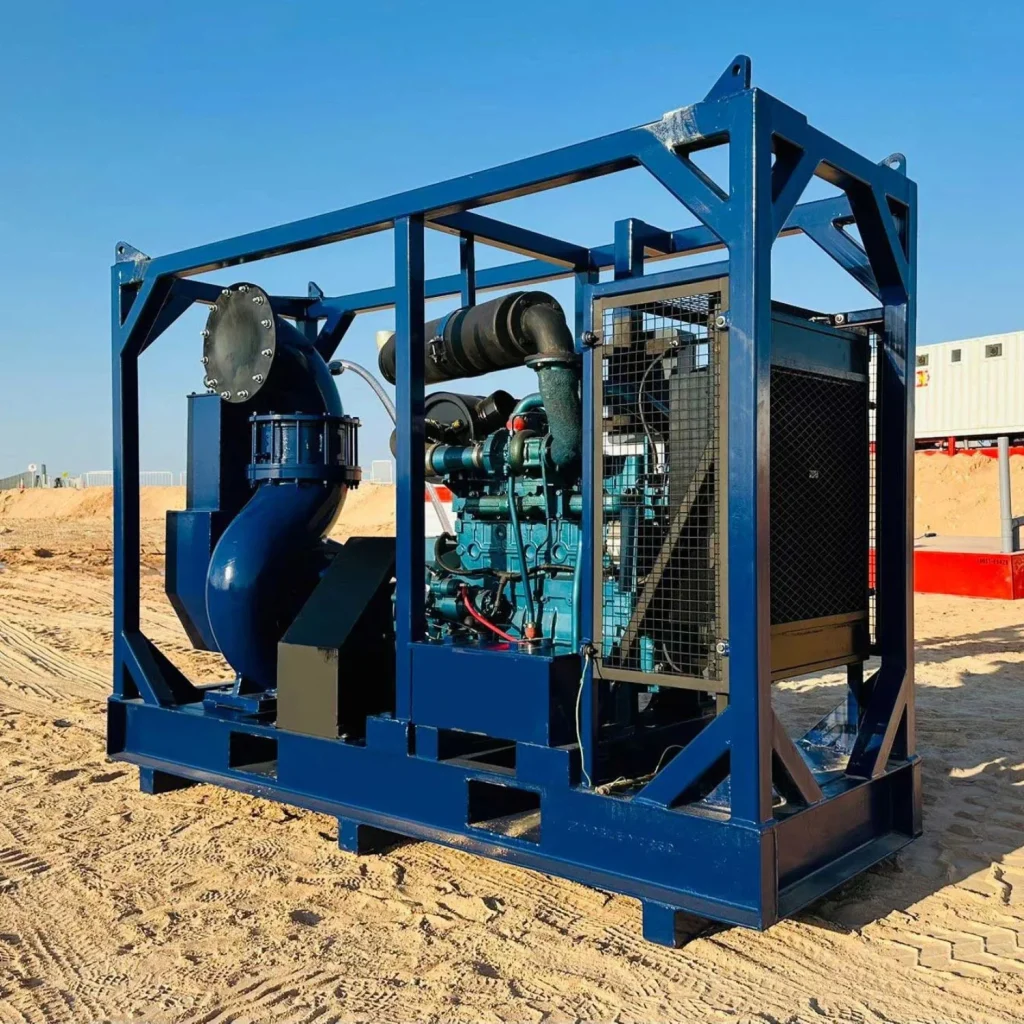
A centrifugal diesel driven dewatering pump is a surface-mounted pumping system in which a diesel engine provides mechanical power to a centrifugal pump.
The pump uses an impeller to move water from the suction side to the discharge side. As the impeller rotates, water enters the pump casing and is accelerated outward. The pump casing then converts part of this velocity into pressure, allowing the water to be transferred through the discharge line.
The diesel engine provides the power required to operate the pump without depending on an external electrical supply.
This combination makes diesel dewatering pumps particularly useful for construction sites, excavation projects, infrastructure works, emergency drainage and other locations where reliable power may not be available.
Racors manufactures a range of dewatering pump systems with diesel and electric configurations, including self-priming designs, different mounting arrangements and multiple pump sizes.
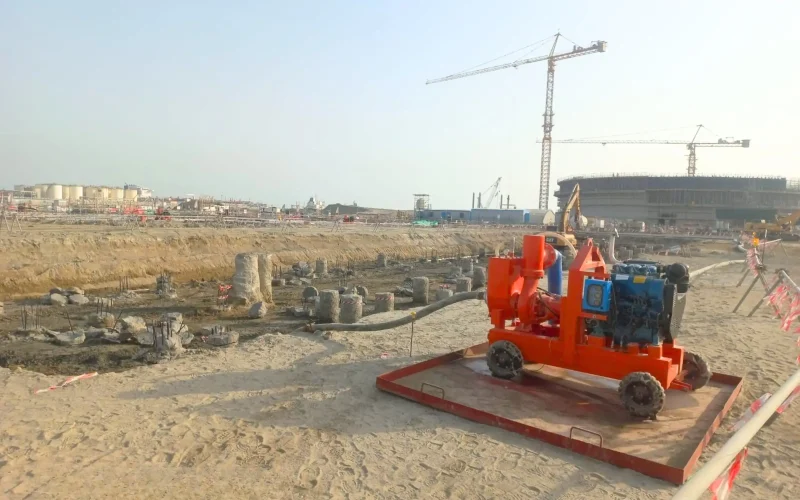
Understanding the basic operating sequence makes it easier to select and operate the right pump.
1. Water Enters Through the Suction Line
The suction hose or pipe is positioned at the lowest practical point of the excavation, sump, trench or water collection area.
The suction line should be properly sized and installed to reduce unnecessary losses.
2. The Diesel Engine Drives the Pump
The diesel engine supplies mechanical power to the pump.
Unlike an electrically driven pump, the diesel-powered system can operate independently of the site’s electrical grid, provided there is sufficient fuel and the equipment is operated correctly.
3. The Impeller Moves the Water
Inside the centrifugal pump, the rotating impeller transfers energy to the water.
The resulting flow is directed through the volute or casing toward the discharge outlet.
4. Water Is Discharged Away From the Work Area
The pumped water travels through the discharge hose or pipeline to an approved discharge point, settlement system, drainage channel or other designated location.
The discharge arrangement should always be planned according to the project requirements and applicable environmental and site regulations.
5. Self-Priming Helps Restart the Pump
Many modern dewatering systems use automatic or vacuum-assisted self-priming technology.
Racors describes its systems as using vacuum-assisted self-priming to remove air from the suction line and support automatic starting and continuous pumping.
Construction sites do not always have stable electrical power.
An excavation may be located away from permanent electrical infrastructure, or the contractor may need a pump that can be moved between different work areas.
A diesel-driven pump provides an independent power source.
Key advantages include:
- Independent operation from the electrical grid
- Suitable for remote construction sites
- High-volume water transfer capability
- Continuous-duty operation when correctly specified
- Easy movement between suitable work areas
- Suitable for emergency pumping applications
- Available in different pump sizes and configurations
- Useful for construction, excavation and drainage projects
Diesel-powered centrifugal pumps are also used in broader dewatering applications where high flow and mobility are important. Industry pump ranges commonly include diesel centrifugal systems for construction, general dewatering, drainage and emergency applications.
For a dewatering contractor, pump reliability is directly connected to project performance.
A pump may need to operate for extended periods while groundwater continues entering the excavation. Stopping the pump unexpectedly can allow the water level to rise again.
This is why contractors generally look beyond the purchase price.
They consider:
- Pump performance
- Flow capacity
- Total head
- Suction lift
- Priming performance
- Engine reliability
- Fuel capacity
- Ease of maintenance
- Spare parts availability
- Pump mobility
- Solid-handling capability
- Site conditions
- Expected operating hours
For example, Racors’ 6-inch model lists a maximum water flow of up to 350 m³/hr, maximum head of 40 m and maximum suction lift of 9 m, although actual performance depends on the operating point and site conditions.
The important point is that pump size alone does not determine performance.
The complete hydraulic duty must be considered.
A centrifugal diesel driven dewatering pump can become one of the most important pieces of equipment on a construction or excavation site when water needs to be controlled continuously.
The real value of the pump is not simply how much water it can move.
It is how reliably the complete system can maintain the required water level under actual site conditions.
Before choosing a pump, contractors should evaluate flow rate, total head, suction lift, water quality, solids content, operating hours, engine requirements, hose arrangement and maintenance support.
For projects in Dammam, Al Khobar and Jubail, these factors become especially important when the equipment is expected to operate in demanding construction and industrial environments.
The right pump, correctly selected and properly installed, can help contractors maintain a safer and more productive work area while reducing unnecessary pumping delays.
Racors provides centrifugal diesel driven dewatering pump solutions for construction, excavation, industrial, infrastructure and water-management applications. Contact Racors to discuss your project requirements and select the appropriate pump configuration.
F.A.Q.
A centrifugal diesel driven dewatering pump is a surface-mounted pump powered by a diesel engine that removes groundwater, rainwater, and accumulated water from construction sites, excavations, trenches, and industrial projects.
Contractors prefer diesel dewatering pumps because they operate independently of electrical power, offer high pumping capacity, are easy to transport, and perform reliably in remote construction and infrastructure projects.
These pumps are widely used in construction dewatering, excavation works, foundation projects, pipeline trenching, road construction, industrial sites, mining operations, flood control, and emergency water removal applications.
Yes. Centrifugal diesel driven dewatering pumps are widely used across Dammam, Al Khobar, and Jubail for construction, industrial, oil & gas, infrastructure, and groundwater control projects where reliable water management is essential.
Self-priming dewatering pumps automatically remove air from the suction line, allowing faster startup, reduced downtime, easier operation, and improved efficiency on demanding dewatering sites.